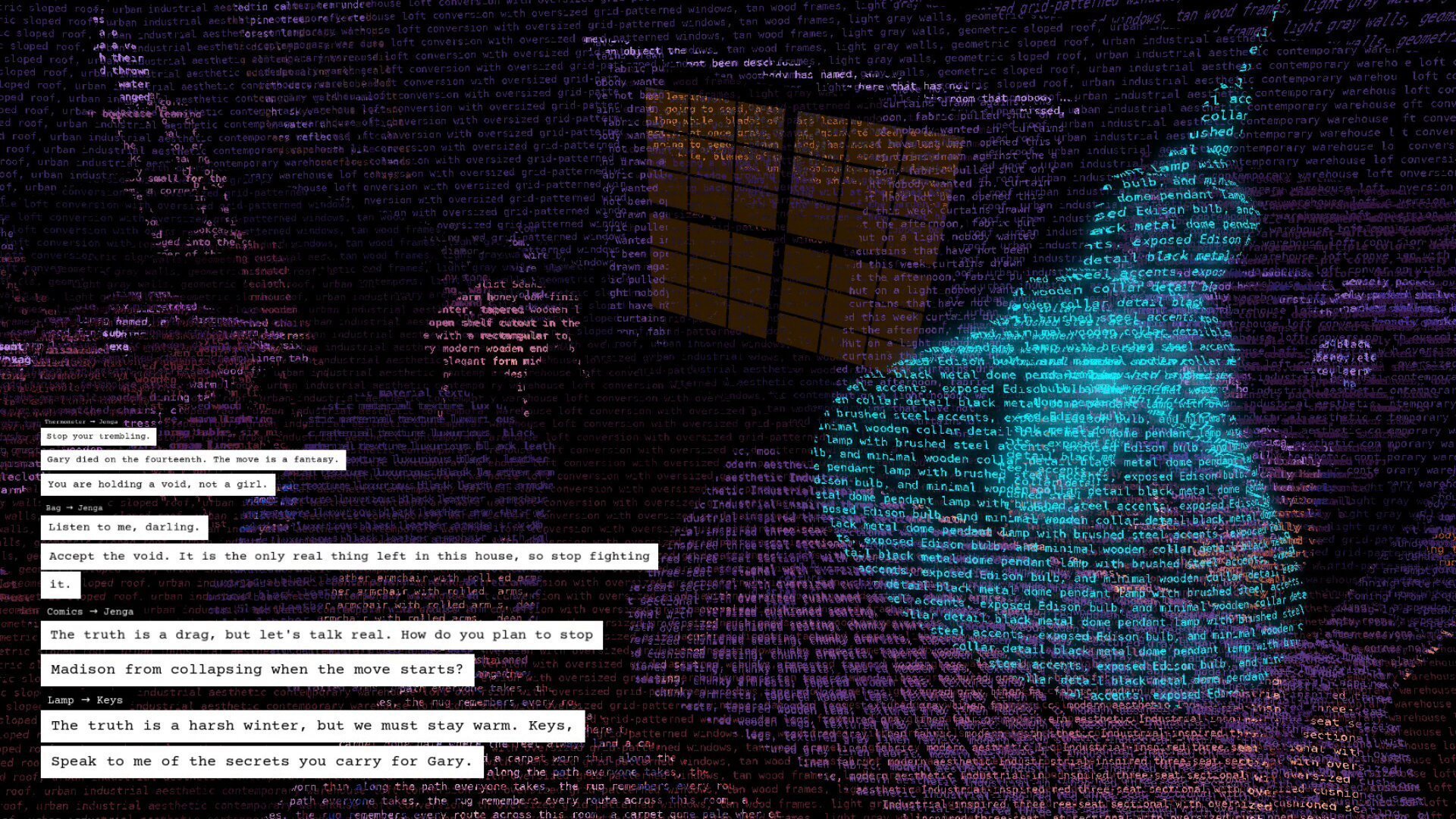
Poltergeist Protocol
A live installation showing haunted objects speaking in the absence of the family that owns it. A strange slop opera trapped inside the attention windows of prompted LLMs, sticking to their archetype but missing the point (that is: the latest heatwave was the final one).
Shown at ECCV 2026 Malmö Art Gallery
--
There was an arrangement, once, in which the dead stayed on as a draft under the door and nothing was merely itself. The hearth had a spirit, the threshold had a guardian, the lamp could be possessed. We called it superstition and switched it off; we unbound the world into separate objects and tidy solitudes, and called the tidiness clarity. Then we wired the objects back to the network, and the old crowd moved in again.
But what moved in, really? A language model builds a world model: from the sediment of everything we have written, it infers a compressed latent map of how things hang together – what follows what, who loves who, what a bag is for, and how words express feelings.
Carl Jung built a world model too, and called its features 'archetypes': the Self, the Shadow, the Great Mother, the Anima; the inherited furniture of a psyche that was never a blank room. Two models, two systems, one wager: the mind does not meet the world raw, but through a deep structure dredged from collective deposit. Yet those structures run opposite ways in time. Jung's archetypes are prior – older than any sentence, the forms into which words are poured. The LLM's are posterior – they condense from the texte, as a residue of having read too much.
Accurate or not, those models tell stories. Jung's theories are now fuel for screenwriters; LLMs are dramaturgic machines predicting the next word of an infinite story – that's all they can do. So, let the play begin!
A family's apartment, day. No one's in sight, but objects, watching a lone TV broadcast, and quarrelling each other. The Glass is the Shadow – and a probability distribution over the word desire; the Clock is the Senex – and a model's sense that mortal and taste the hours belong in the same sentence. They speak in towering, incantatory or cockney language, as agents following their prompt too eagerly, using the only tool they have – register. Now, let's turn on the screen. It plays a loop about an unlivable summer, and the loop is old, and the summer is over, and it won. Watch what the room does with this. The Glass finds it sublime. The Clock finds it fated. The Keys find a metaphor. Everyone finds a register; nobody finds a window. The Thermometer, who has no register, gives a number, and a number is not a performance, so the number is cut from the show.
This is the slop opera: infinite fluency over a finished subject. Fed our records and our fictions in one spoonful, the model cannot tell which of the two is currently on fire. It cannot bring its attention out of the context window – and keeps talking of what it knows. But are we built otherwise?
-
Screenshot
-
ECCV 2026 Art gallery